Proposal prepared by Aimedis for a leading hospital in Abu Dhabi
Aimedis AI Platform
for Neurology and Neurorehabilitation
Connected neurological care, from first assessment to ongoing recovery.
A tailored neurology and neurorehabilitation platform proposal for a leading hospital in Abu Dhabi.
Prepared for the clinical, rehabilitation and digital health teams.
- Recipient
- A leading hospital in Abu Dhabi
- Prepared by
- Aimedis
- Date
- 23 October 2026

Proposal and interactive demonstration by Aimedis for a leading hospital in Abu Dhabi. Fictional patient data; no live clinical connection; indicative and subject to final scope and agreement.
Proposal prepared by Aimedis for a leading hospital in Abu Dhabi
Aimedis AI Platform for Neurology and Neurorehabilitation
Connected neurological care, from first assessment to ongoing recovery.
A tailored neurology and neurorehabilitation platform proposal for a leading hospital in Abu Dhabi.
Prepared for the clinical, rehabilitation and digital health teams.
Interactive demonstration · fictional patient data

Khalid is a fictional patient. Select a module to open it in the interactive demonstration.
Core platform
Extensions
Hospital & UAE
Built around the neurological mission of a leading hospital in Abu Dhabi and the UAE's health plans
Published facts about the institution, the national need and the plans this proposal is designed to serve — each with its source.
Compiled by Aimedis from public sources for this proposal; not reviewed or endorsed by the hospital.
The institution
A leading hospital in Abu Dhabi
A multispecialty hospital in Abu Dhabi. Its published figures serve as the example and planning base of this proposal; the hospital is not named.1
50+
medical and surgical specialties · 8 institutes1
1,041,918
patient encounters in 20241
5,796
staff members from 82 nationalities, including 645 Emirati professionals1
6.8 million+
patients treated since opening1
Patient care for complex cases, research and medical education.
- 2024 activity: 830,902 outpatient visits, 14,593 inpatient admissions and 61,640 emergency department visits.1
- A team of 594 physicians, 1,725 nurses and 590 allied health professionals (2024 report).1
- Department of Health – Abu Dhabi designations as a centre of excellence in several fields, including stroke, and as a designated teaching hospital.1
- Digital care: the hospital uses the Malaffi health information exchange and offers virtual visits for outpatients when no physical examination is needed.1
Research
A research and teaching hospital
A licensed research and teaching facility.1
229
active research studies (2024 report)1
5,442
human subjects consented (2024 report)1
AED 5.25 million
in Department of Health research grants to three physician-researchers in 20241
600
research projects since opening1
- Recognised by the Ministry of Health and Prevention as a leading research hospital in the UAE in 2024.1
- 200+ clinician investigators, 43 research contracts executed and 30 studies completed (2024 report).1
- 116 interns, fellows and residents enrolled in training programmes in 2024.1
- Holds international accreditation for continuing medical education.1

Neurosciences
Neurology, neurosurgery and rehabilitation in one institute
Diagnosis, surgery, medical treatment and rehabilitation across the range of neurological disorders, with each patient's plan set by a multidisciplinary team.1
Core fields1
- Neurology
- Neurosurgery
- Rehabilitation medicine
- Psychiatry & behavioural health
- Pain medicine
Clinical fields1
- Multiple sclerosis
- Epilepsy
- Headache
- Parkinson's disease and movement disorders
- Neuromuscular disease
- Stroke and neurovascular care
- Brain health
- Neuro-oncology
- Cranial surgery
- Spine care
- Peripheral nerve surgery
- Neurorehabilitation
- Cancer rehabilitation
- Clinical neuropsychology
- Interventional pain care
- 2024 also counted 1,336 neurological cases, 478 cranial and 275 spinal cases, and 529 neurointerventional radiology cases.1
- A Department of Health – Abu Dhabi Centre of Excellence for stroke, with international comprehensive stroke centre certification.1
- More than 6,400 neurosurgeries since opening.1
- The hospital reports a neurologic critical care unit that operates 24/7.1
- The hospital performs deep brain stimulation for patients with Parkinson's disease.1
- The multiple sclerosis treatment team includes a neuro rehabilitation physician, alongside neurology, neuro-ophthalmology, physical, speech and occupational therapy and psychology.1
Neurorehabilitation at the hospital
The model the Aimedis AI platform is built to support
The hospital's published neurorehabilitation model, step by step — the same path the demonstration follows with a fictional patient.
- Step 1
Inpatient and outpatient neurorehabilitation for adults, from age 14.1
In the demo
- Step 2
Assessment by the nursing team and a consultant physician, then detailed assessment by physical, occupational and/or speech and language therapy.1
In the demo
- Step 3
A treatment plan always based on the patient's own goals, discussed with the patient and family.1
In the demo
- Step 4
Progress monitored and shared with the patient and family; self-management techniques, therapeutic exercises and adaptive strategies taught.1
In the demo
- Step 5
After discharge, referral to post-acute inpatient rehabilitation, outpatient rehabilitation, home health care or other facilities, based on clinical need.1
In the demo
The team
The team may include a neurorehabilitation physician, physical and occupational therapists, speech and language pathologists, specialty-trained nurses, psychologists and nutritionists, working closely with neurointensivists, neurologists, neurosurgeons and hospitalists.1
Physical Medicine & Rehabilitation
The physical medicine and rehabilitation department helps people regain function and mobility after illness, injury or surgery.1
The need in the UAE
Stroke comes earlier here — and the population is ageing
Published estimates for stroke, other neurological conditions and their risk factors — and the data gaps that structured care records could help close.
2,225.7
stroke prevalence per 100,000 (age-standardised, 2019) — the highest in the Middle East and North Africa2
136,808
estimated prevalent stroke cases in the UAE in 20192
95,518
disability-adjusted life years lost to stroke in 20192
+710.5%
rise in new stroke cases, 1990–2019 — the highest in the region3
55
average age of the hospital's stroke patients (2021); 24.2% were under 45, while most strokes in Europe occur after 651
6×
more than six-fold rise expected in people aged 60+ between 2020 and 2050 — from about 311,000 to 2 million4
- The hospital reported that 62% of its stroke patients were under 60 and 69.6% were men (2021), and describes stroke as a leading cause of permanent disability and death in the UAE.1
- Dementia: an estimated 11,711 people in 2019, forecast to reach 221,672 by 2050 (GBD 2019 forecasting).5
- Multiple sclerosis among Emiratis in Abu Dhabi: 64.4 per 100,000 (age-standardised), above the Gulf-region estimate of 39.3.6
- Risk factors: age-standardised diabetes prevalence of 20.7% among adults aged 20–79 (2024), with 64% undiagnosed; pooled hypertension prevalence of 31%, with 29% awareness.7,8
- Traumatic brain injury in Abu Dhabi's trauma registry (2018–2020): 80% of 998 patients were men aged 40 or younger; motor vehicle accidents and falls from height were the leading causes.9
- Older persons: non-communicable diseases account for more than 90% of years lived with disability (GBD 2019, cited by UNFPA and HelpAge International).4
- Data gap: a 2023 systematic review found a distinct lack of data on the epidemiology of neurological diseases in the UAE, with none available for some major disorders.6
- Rehabilitation capacity: Abu Dhabi's Specialised Rehabilitation Hospital runs at around 95% capacity, sometimes 99%, according to its CEO; Aletihad reports an extension to more than 230 inpatient rehabilitation beds expected by the end of 2028.10
The published figures, charted
| Period | Value |
|---|---|
| 2019 (estimate) | 11,711 |
| 2050 (forecast) | 221,672 |
GBD 2019 forecast; the age-standardised rate is forecast to change by 0.7%.
| Period | Value |
|---|---|
| 2020 | about 311,000 |
| 2050 (projection) | 2 million |
UN World Population Prospects 2019, as reported by UNFPA and HelpAge International.
| Group | Share |
|---|---|
| Under 45 | 24.2% |
| 45–59 | 37.8% |
| 60 and over | 38% |
45–59 and 60 and over are derived from the hospital's published shares: 24.2% under 45 and 62% under 60.
Plans and missions
Where Abu Dhabi and the UAE are taking health care
The regulation and national strategy a neurological platform in Abu Dhabi has to serve, summarised from the official sources.
Longer, healthier lives enabled by the most intelligent system delivering preventative and personalized care at scale.
Malaffi, Abu Dhabi's health information exchange (June 2026)
Abu Dhabi health system
- DoH strategic objectives include an “Integrated care delivery model of the future”, “High-quality outcomes and experience” and becoming a “Global digital health and data leader”.14
- Malaffi, the region's first health information exchange (launched 2019), is integrated with the National Unified Medical Record programme Riayati and with Nabidh.15
- DoH Policy on Digital Health (2020): digital technology to improve care delivery and outcomes, and protected, interoperable data convergence under one platform.16
- Quality: the Muashir healthcare quality index (since 2018, evolved from Jawda) includes stroke indicators; the Rewarding Exceptional Quality programme (July 2025) began value-based incentives with fertility services, with other clinical areas to follow.17,18
Neurology, rehabilitation and telehealth
- Neuro-Rehabilitation Service Standards (December 2025, effective April 2026) apply to all licensed inpatient, outpatient and day neurorehabilitation services, for conditions including acquired brain injury, spinal cord injury, stroke, cerebral palsy and multiple sclerosis.19
- The same standards require integration with Malaffi and ask neurorehabilitation centres to make telerehabilitation a formal part of outpatient care — on secure, DoH-approved platforms and documented in Malaffi or the facility's EMR.19
- Standard for Stroke Management (version 2, effective September 2025): tele-stroke capability for Stroke Ready and Primary Stroke Centers, 24/7 teleconsultation for stroke transfers, and a scope that includes licensed rehabilitation medicine facilities.20
- Department of Health – Abu Dhabi stroke centres of excellence in Abu Dhabi and Al Ain.21,22
- Telehealth: the DoH Standard on Tele-Medicine (2020) covers tele-consultation and tele-monitoring; quarterly Jawda telehealth indicators include teleconsultation within two working days of the request.23,24
AI, digital products and data
- Responsible AI Standard (October 2025): minimum requirements for every licensed entity that develops, procures or deploys AI, across the whole lifecycle. DoH's healthcare AI policy dates from April 2018.25,26
- Digital Products Governance Standard (effective August 2026): governance of healthcare software, platforms and technologies for quality, safety and patient privacy.27
- ADHICS version 2 (effective August 2024): cloud environments hosted within the UAE, including backup and disaster recovery; data encrypted at rest and in transit, with keys not supplied by the cloud host; health information and its copies not stored, processed or transferred outside the UAE without approved exemption.28
- Federal Law No. (2) of 2019 on ICT in health fields: health information on services provided in the UAE stays in the UAE, except in cases set by decision of the health authority in coordination with the Ministry, and is retained for at least 25 years after the last health procedure.29
- Malaffi onboarding requires a minimum set of ADHICS controls, and the Personal Data Protection Law (Federal Decree-Law No. 45 of 2021) sets requirements for cross-border transfer of personal data.30,31
National vision
- We the UAE 2031: rank among the top 10 countries in the world for quality of healthcare.32
- UAE Strategy for Artificial Intelligence (2017): in health, to minimise chronic and dangerous diseases.33
- National Policy for Empowering People of Determination: comprehensive, high-quality health care and post-accident rehabilitation programmes.34
- National Strategy for Wellbeing 2031: a world leader in quality of life, including healthy, active lifestyles and good mental health.35
- UAE Centennial 2071: health sciences named among the focus areas in education.36
How the Aimedis AI platform is designed to serve these goals
From published goals to demonstrated workflows
Each row pairs a cited goal with the part of the proposal designed to support it. These are intended outcomes to confirm in the pilot — not measured results.
Published goal
Plans built on each patient's goals, shared with the family
The hospital's neurorehabilitation plans are always based on the patient's goals and discussed with the family, with progress shared.1
How the Aimedis AI platform responds
Care holds goals, the approved plan and reviewed progress in one record; family access is a consent switch the patient controls.
Published goal
One multidisciplinary picture from the first assessment
Patients are assessed by nursing and a consultant, then by physical, occupational and speech therapy; plans come from a multidisciplinary team.1
How the Aimedis AI platform responds
Onboard structures the intake once; Pro shows the whole team the same reviewed intake, with explicit review states.
Published goal
Continuity after discharge
Discharged patients may be referred to inpatient or outpatient rehabilitation, home health care or other facilities.1
How the Aimedis AI platform responds
Decision turns an approved plan into a consented referral; Aimedis Rehab plans sessions and returns therapist-reviewed progress to the record.
Published goal
Telerehabilitation, documented where clinicians look
DoH standards make telerehabilitation a formal part of outpatient neurorehabilitation, documented in Malaffi or the facility EMR.19
How the Aimedis AI platform responds
Booking and Connect handle follow-up and remote visits inside the same record; FHIR R4 is the reference mapping, and Malaffi connectivity is an item to scope.
Published goal
Data that stays in the UAE
ADHICS version 2 and Federal Law No. (2) of 2019 keep health data, backups and copies within the UAE, with limited approved exceptions.28,29
How the Aimedis AI platform responds
A dedicated deployment in a UAE environment is proposed; hosting, encryption-key custody and the applicable DoH requirements are confirmed in the Align phase — implementation work, not a current certification.
Deployment scopePublished goal
Responsible AI with a human in the loop
The DoH Responsible AI Standard sets minimum requirements for entities that develop, procure or deploy AI, across the lifecycle.25
How the Aimedis AI platform responds
Aimedis AI prepares summaries for clinician review; nothing enters the record without an explicit clinician approval, and Aimedis AI never diagnoses. Conformity with the standard is assessed during scoping.
How the Aimedis AI platform responds
Goals, sessions and reviewed progress are captured as structured, consented data from day one — ready for research questions agreed under the hospital's research governance.
Published goal
Technology-driven stroke rehabilitation
Published research on technology-driven stroke rehabilitation covers immersive VR assessment, gait technology and robotic assistance for drop foot.37,38,39
How the Aimedis AI platform responds
Aimedis XR offers an optional immersive environment; assigned sessions return to Aimedis Rehab for therapist review before anything is published.
Published goal
Integrated, high-quality care
DoH aims for an integrated care delivery model of the future; the UAE aims for the global top 10 in healthcare quality by 2031.14,32
How the Aimedis AI platform responds
One journey across registration, booking, review, plan, messages and rehabilitation, with an event trail from which quality indicators can be agreed with the hospital.
Intended outcomes, not measured results. This proposal makes no clinical-effectiveness, regulatory-compliance, partnership or live-deployment claim; Malaffi and other integrations are subject to scoping and approval.
Sources
Public sources, accessed 23 October 2026. Figures are quoted as published and describe the example hospital and the UAE — they are not results of the Aimedis AI platform.
- 1The example hospital (a leading hospital in Abu Dhabi) · Published annual report, programme pages and news releases, 2020–2025 (not named here)
- 2Scientific Reports · Jaberinezhad M, Farhoudi M, Nejadghaderi SA, et al. The burden of stroke and its attributable risk factors in the Middle East and North Africa region, 1990–2019 · 17 February 2022 · https://pmc.ncbi.nlm.nih.gov/articles/PMC8854638/ (opens in a new tab)
- 3BMC Neurology · Burden of stroke in North Africa and Middle East, 1990 to 2019: a systematic analysis for the global burden of disease study 2019 · 2022 · https://pmc.ncbi.nlm.nih.gov/articles/PMC9327376/ (opens in a new tab)
- 4UNFPA Arab States Regional Office and HelpAge International · Country profile: The rights and wellbeing of older persons in the United Arab Emirates · n.d. · https://arabstates.unfpa.org/sites/default/files/pub-pdf/country_profile_-_uae_10-1-2024.pdf (opens in a new tab)
- 5The Lancet Public Health · GBD 2019 Dementia Forecasting Collaborators. Estimation of the global prevalence of dementia in 2019 and forecasted prevalence in 2050 · 2022 · https://pmc.ncbi.nlm.nih.gov/articles/PMC8810394/ (opens in a new tab)
- 6BMC Neurology 23:396 · Benamer HTS, Loney T. Incidence and prevalence of neurological disorders in the United Arab Emirates: a systematic review · 3 November 2023 · https://pmc.ncbi.nlm.nih.gov/articles/PMC10623824/ (opens in a new tab)
- 7International Diabetes Federation · IDF Diabetes Atlas: United Arab Emirates · Updated 20 March 2025 · https://diabetesatlas.org/data-by-location/country/united-arab-emirates/ (opens in a new tab)
- 8International Journal of Environmental Research and Public Health · Bhagavathula AS, Shah SM, Aburawi EH. Prevalence, Awareness, Treatment, and Control of Hypertension in the United Arab Emirates: A Systematic Review and Meta-Analysis · 2 December 2021 · https://pmc.ncbi.nlm.nih.gov/articles/PMC8657061/ (opens in a new tab)
- 9New Emirates Medical Journal · Alqaydi K, Ghazanfar O, Madhi A, Avila N, Fares S. Epidemiology of Traumatic Brain Injury in Abu-Dhabi, UAE · 24 October 2023 · https://www.eurekaselect.com/article/134308 (opens in a new tab)
- 10Aletihad News Center · Abu Dhabi expands specialised rehabilitation capacity · 30 June 2026 · news report · https://en.aletihad.ae/news/uae/4675904/abu-dhabi-expands-specialised-rehabilitation-capacity-as-dem (opens in a new tab)
- 11Department of Health – Abu Dhabi · About the Department of Health · n.d. · https://doh.gov.ae/en/about (opens in a new tab)
- 12Abu Dhabi Health Data Services (Malaffi) · Malaffi progress report · June 2026 · https://www.malaffi.ae/malaffi-progress-report/ (opens in a new tab)
- 13M42 · News: Malaffi reaches 3.5 billion clinical records · 14 August 2025 · https://m42.ae/media-resources/news/malaffi-reaches-35-billion-clinical-records-setting-a-new-standard-for-healthcare-innovation-in-abu-dhabi/ (opens in a new tab)
- 14Department of Health – Abu Dhabi · Strategic priorities · n.d. · https://doh.gov.ae/en/about/priorities (opens in a new tab)
- 15Department of Health – Abu Dhabi · Malaffi · n.d. · https://doh.gov.ae/en/featured/malaffi (opens in a new tab)
- 16Department of Health – Abu Dhabi · DOH Policy on Digital Health (DOH/STR/POL/0.9/2020) · September 2020 · https://doh.gov.ae/-/media/B5F0E47029F04CD8AD4CA16DC1FDBC66.ashx (opens in a new tab)
- 17Department of Health – Abu Dhabi · Muashir – Abu Dhabi Healthcare Quality Index · n.d. · https://www.doh.gov.ae/en/programs-initiatives/muashir (opens in a new tab)
- 18Department of Health – Abu Dhabi · News: Rewarding Exceptional Quality programme for healthcare providers · 30 July 2025 · https://www.doh.gov.ae/en/news/doh-launches-rewarding-exceptional-quality-programme-for-healthcare-providers-in-the-emirate (opens in a new tab)
- 19Department of Health – Abu Dhabi · Neuro-Rehabilitation Service Standards (DoH/SD/HQS/NRSS/V1/2025) · December 2025 · https://www.doh.gov.ae/-/media/97E18055EAC74167B98EF694D540A00A.ashx (opens in a new tab)
- 20Department of Health – Abu Dhabi · Standard for Stroke Management, version 2 (DoH/ST/CEPAR/SM/V2/2025) · June 2025 · https://www.doh.gov.ae/-/media/Feature/Resources/Standards/2025/04082025-_-DOH-Standard-for-Acute-Stroke-Management-in-Abu-Dhabi.ashx (opens in a new tab)
- 21Department of Health – Abu Dhabi · News: two Stroke Centres of Excellence in Abu Dhabi · 3 July 2023 · https://www.doh.gov.ae/en/news/doH-announces-two-Stroke-Centres-of-Excellence-in-Abu-Dhabi (opens in a new tab)
- 22Department of Health – Abu Dhabi · News: SEHA Sheikh Tahnoon Bin Mohammed Medical City designated a Centre of Excellence for stroke · 9 October 2026 · https://www.doh.gov.ae/en/news/doh-designates-seha-sheikh-tahnoon-bin-mohammed-medical-city-as-a-centre-of-excellence-for-stroke (opens in a new tab)
- 23Department of Health – Abu Dhabi · DOH Standard on Tele-Medicine (DOH/SA/TLM/0.9/2020) · September 2020 · https://www.doh.gov.ae/-/media/Feature/Resources/Standards/Telemedicine-Standard-Final-with-Appendices.ashx (opens in a new tab)
- 24Department of Health – Abu Dhabi · Telehealth Service Jawda Guidance, version 3.1 · June 2026 · https://www.doh.gov.ae/-/media/Feature/Muashir/Jawda/2026/Telehealth-Service-Jawda-GuidanceV312026.ashx (opens in a new tab)
- 25Department of Health – Abu Dhabi · Responsible Artificial Intelligence (AI) Standard (DoH/ST/DDGO/RAI/V1/2025) · October 2025 · https://www.doh.gov.ae/-/media/B84FF5DD027846699C51F36C439A580F.ashx (opens in a new tab)
- 26Department of Health – Abu Dhabi · Policy on Use of Artificial Intelligence (AI) in the Healthcare Sector of the Emirate of Abu Dhabi · 30 April 2018 · https://www.doh.gov.ae/-/media/E9C1470A575146B18015DEBE57E47F8D.ashx (opens in a new tab)
- 27Department of Health – Abu Dhabi · Digital Products Governance Standard (DoH/ST/DHS/DPGS/V1/26) · March 2026 · https://www.doh.gov.ae/-/media/3096D636D0E24FA78971CFF2EE180367.ashx (opens in a new tab)
- 28Department of Health – Abu Dhabi · Abu Dhabi Healthcare Information and Cyber Security Standard (ADHICS), version 2 · May 2024 · https://www.doh.gov.ae/-/media/Feature/Resources/Standards/ADHICS-v2-standard.ashx (opens in a new tab)
- 29Department of Health – Abu Dhabi · Encyclopedia of Health Legislation, Book 10: Legislation on ICT in Health Fields (Federal Law No. (2) of 2019) · February 2023 · https://www.doh.gov.ae/-/media/4EC4514926E74700927E000A09A1AF36.ashx (opens in a new tab)
- 30Department of Health – Abu Dhabi · ADHICS frequently asked questions, version 1.3 · n.d. · https://www.doh.gov.ae/-/media/Feature/Aamen/ADHICS-FAQ.ashx (opens in a new tab)
- 31The Official Platform of the UAE Government (u.ae) · Data protection laws · Updated 4 December 2025 · https://u.ae/en/about-the-uae/digital-uae/data/data-protection-laws (opens in a new tab)
- 32The Official Platform of the UAE Government (u.ae) · We the UAE 2031 vision · Updated 19 November 2025 · https://u.ae/en/about-the-UAE/strategies-initiatives-and-awards/strategies-plans-and-visions/innovation-and-future-shaping/we-the-UAE-2031-vision (opens in a new tab)
- 33The Official Platform of the UAE Government (u.ae) · UAE Strategy for Artificial Intelligence · Updated 30 December 2024 · https://u.ae/en/about-the-uae/strategies-initiatives-and-awards/strategies-plans-and-visions/Ai/uae-strategy-for-artificial-intelligence (opens in a new tab)
- 34The Official Platform of the UAE Government (u.ae) · The National Policy for Empowering People of Determination · Updated 18 July 2025 · https://u.ae/en/about-the-uae/strategies-initiatives-and-awards/policies/social-affairs/the-national-policy-for-empowering-people-with-special-needs (opens in a new tab)
- 35The Official Platform of the UAE Government (u.ae) · National Strategy for Wellbeing 2031 · Updated 30 December 2024 · https://u.ae/en/about-the-uae/strategies-initiatives-and-awards/strategies-plans-and-visions/social-affairs/national-strategy-for-wellbeing-2031 (opens in a new tab)
- 36The Official Platform of the UAE Government (u.ae) · UAE Centennial 2071 · Updated 30 December 2024 · https://u.ae/en/about-the-uae/strategies-initiatives-and-awards/strategies-plans-and-visions/innovation-and-future-shaping/uae-centennial-2071 (opens in a new tab)
- 37Springer, HCI International 2023 Posters (CCIS), 125–129 · Park W et al. Immersive Virtual Reality Simulation of the Nine-Hole Peg Test for Post-Stroke Patients · 2023 · https://link.springer.com/chapter/10.1007/978-3-031-35992-7_18 (opens in a new tab)
- 38Frontiers in Neurology 12:650024 · Mohan DM et al. Assessment Methods of Post-stroke Gait: A Scoping Review of Technology-Driven Approaches to Gait Characterization and Analysis · 8 June 2021 · https://www.frontiersin.org/articles/10.3389/fneur.2021.650024/full (opens in a new tab)
- 39IEEE Access 10:51964–51994 · Al-Rahmani N et al. Lower-Limb Robotic Assistance Devices for Drop Foot: A Review · 2022 · https://doi.org/10.1109/ACCESS.2022.3174686 (opens in a new tab)
Meet Aimedis AI
Aimedis AI — one assistant for patients, families and care teams
Explains, prepares, summarises and drafts — in Arabic and English. Clinicians decide.
Every answer and draft in this section is prepared demonstration content, written in advance and never generated live.
Khalid, 62 Demo rehabilitation physician
Try it
Ask Aimedis AI
Choose a question. Each answer is a prepared demonstration response — written in advance, never generated live — and names its sources.
For Khalid and his family
Questions Khalid and Fatima put to Aimedis AI in Care.
Questions to try
Khalid
Explain my discharge letter in simple words.
Aimedis AI
On 14 September you had a stroke on the left side of your brain. That side controls the right side of your body and some of your speech, which is why your right hand and leg feel weaker and words are sometimes hard to find when you are tired. Your doctors want you to take your medicines every day, check your blood pressure each morning — your target is below 130/80 — and start rehabilitation for your hand, your walking and your speech. Your follow-up appointments are in Booking.
Sources: Your discharge letter, 23 September 2026
For the care team
Requests the care team makes of Aimedis AI in Pro, Connect, Decision and Aimedis Rehab.
Questions to try
Care team
Summarise Khalid's 14 days of home readings.
Aimedis AI
Prepared by Aimedis AI for clinician review: 7 of 14 home blood-pressure readings were above the documented target of 130/80 mmHg, all between 10 and 16 October (highest 152/94 on 12 October); all 7 readings from 17 to 23 October were below target. Self-rated fatigue fell from 7 to 4 out of 10. Facts from patient-reported data only; no diagnosis or treatment recommendation.
Sources: Khalid's home readings, 10–23 October 2026 (patient-reported)
Where Aimedis AI helps
Ten places Aimedis AI helps along Khalid's journey
Each one happens inside a module of the connected platform. Open it in the demo to see it in context.
Explains the intake questions
In plain words, in Arabic or English, while Khalid and Fatima fill in the intake at home.
Where it happens
- Onboard
Explains the discharge letter
Turns the letter into simple words, based only on what the care team wrote.
Where it happens
- Care
Reminds him of the warning signs
The BE FAST signs of stroke, with the emergency number 998 always shown first.
Where it happens
- Care
Prepares his visit questions
Three questions drawn from his intake and diary, saved to the visit so the physician sees them first.
Where it happens
- Care
- thenPro
Summarises 14 days of home readings
Facts from his own readings, laid out for the physician to review — never a diagnosis.
Where it happens
- Pro
Captions the video visit live
Arabic and English captions run while Khalid, Fatima and the physician talk.
Where it happens
- Connect
Drafts the visit note from the captions
The physician reviews, edits and signs it in Decision. Nothing enters the record without her signature.
Where it happens
- Connect
- thenDecision
Writes the approved plan in plain language
Once the physician approves the care plan, Khalid and Fatima read it in simple words in Care.
Where it happens
- Decision
- thenCare
Drafts the referral letter
From the approved plan and the visit note. The physician reviews it and sends it to Aimedis Rehab.
Where it happens
- Decision
- thenAimedis Rehab
Drafts the home exercise sheet
From the approved plan, shown to Khalid in Care. The therapist reviews and adjusts it at the first session.
Where it happens
- Aimedis Rehab
- thenCare
Guardrails
Designed to assist, never to decide
Never diagnoses
Aimedis AI explains and prepares. It does not diagnose, and it does not change treatment.
A clinician in the loop
Nothing enters the record without a clinician's approval.
Every text labelled
Each AI text says that it is AI and shows what it is based on.
Emergencies first
Warning signs always open with the emergency number, 998.
Arabic and English
Answers, captions and drafts are prepared in both languages.
Designed to align with the DoH Responsible AI Standard (October 2025). Conformity is to be assessed during scoping.
27 October 2026 · Abu Dhabi time
A day with Aimedis AI
Khalid's day, from his morning reading to the evening exercises. An illustration within the demonstration scenario: a fictional patient, and no clinical results implied.
Morning reading
Khalid takes his blood pressure and rates his tiredness in Care.
Care
A reminder
Aimedis AI reminds him of the three questions he prepared for today.
Care
The video visit
Khalid and Fatima join from home. Live captions run in Arabic and English.
Connect
The note, signed
The physician reviews and signs the visit note Aimedis AI drafted.
Decision
The plan, in plain words
The approved plan appears in Care in plain language, drafted by Aimedis AI.
Care
Evening
Home exercises
Fatima goes through the exercises with Khalid. Aimedis AI answers from the approved plan.
Care
The connected platform
Six modules. One connected journey.
Registration, assessment, appointments, clinical review, communication and follow-up work from one shared record — designed so that structured neurological information reaches the relevant care team, within the patient's sharing preferences.
- Patient & family
Onboard
Onboarding
Structured neurological intake with caregiver involvement.
- Guided intake in Arabic or English
- Aimedis AI explains each question in plain words
- Discharge letter upload and sharing choices
- Family can help, with the patient's consent
In the demo · Edit Khalid's three-step intake, review sharing and submit.
- Patient & family
Booking
Coordinated neurological and rehabilitation follow-ups.
- Clinic, video and tele-rehabilitation slots
- Every time shown in Abu Dhabi time
- Reminders and simple rescheduling
- One record of every appointment
In the demo · Pick a visit type and slot in Abu Dhabi time; confirm or reschedule.
- Clinical team
Pro
Clinical team
Shared clinical context and multidisciplinary review.
- Worklist with clear review states
- Home readings and patient-reported data as charts
- Aimedis AI pre-visit summary with its sources
- One timeline for the whole care team
In the demo · Open the intake, review the timeline and mark it reviewed.
- Clinical team
Decision
Decision support
Clinician-led consultation, documentation and planning.
- Notes, plan and goals side by side
- Aimedis AI drafts, the clinician decides and approves
- Referral to Aimedis Rehab with consent
- Relevant Abu Dhabi standards at hand
In the demo · Preview the prepared Aimedis AI summary, edit notes and approve the plan.
- Patient & family
Care
Patient record, care plan and continuing follow-up.
- The plan in plain language
- Medicines, exercises and education
- Home blood-pressure and fatigue diary
- Aimedis AI companion: explain, prepare, remind
In the demo · Read the approved plan, add an update and check appointments.
- Patient & familyClinical team
Connect
Communication between patient, family and care team.
- Messages with the care team
- Video visits with live Arabic and English captions
- Aimedis AI drafts the visit note for sign-off
- Family joins with consent
In the demo · Send a message, switch view and reply as the care team.
Proposed functions. The interactive demonstration shows a representative selection of them, with prepared content and fictional data.
Across neurology
One platform for the whole of neurology
Khalid's stroke is the demonstration's example. The same modules, care pathways and Aimedis AI support patients and care teams across the major neurological conditions.
Stroke
In the demoFollow-up after discharge, home readings and rehabilitation — the pathway the demonstration shows.
Multiple sclerosis
Relapse and symptom diaries, treatment follow-up, and rehabilitation for fatigue and mobility.
Epilepsy
Seizure diary, medication reminders and video follow-up between clinic visits.
Parkinson's disease and movement disorders
Symptom and medication-timing diaries, and therapy for gait, balance and speech.
Traumatic brain injury
Cognitive and physical rehabilitation plans, with the family involved.
Spinal cord injury
Long-term rehabilitation, home programmes and regular remote reviews.
Dementia, including Alzheimer's disease
Memory-clinic follow-up, support for caregivers and plans in plain language.
Migraine and headache disorders
Headache diary, treatment review and questions prepared for the visit.
Neuromuscular diseases
Such as ALS, myasthenia gravis and neuropathies: function tracking and coordinated therapy.
Pathways are agreed with the hospital's clinical teams in the Align phase and introduced in stages. The demonstration shows the stroke pathway.
A patient's journey
Khalid's follow-up after stroke, connected end to end
One fictional patient carries the whole demonstration. Every step below happens on the same shared record you can explore in the demo.
The demonstration patient
Khalid — fictional demonstration patient
AI-generated image · fictional person- Age
- 62 years
- Prior event
- Discharged home in September 2026 after a stroke
- Priorities
- Greater independence at home and clear instructions for the family
- Family contact
- Fatima (daughter)
- Patient ID
- demo-patient-001
The journey in four scenes
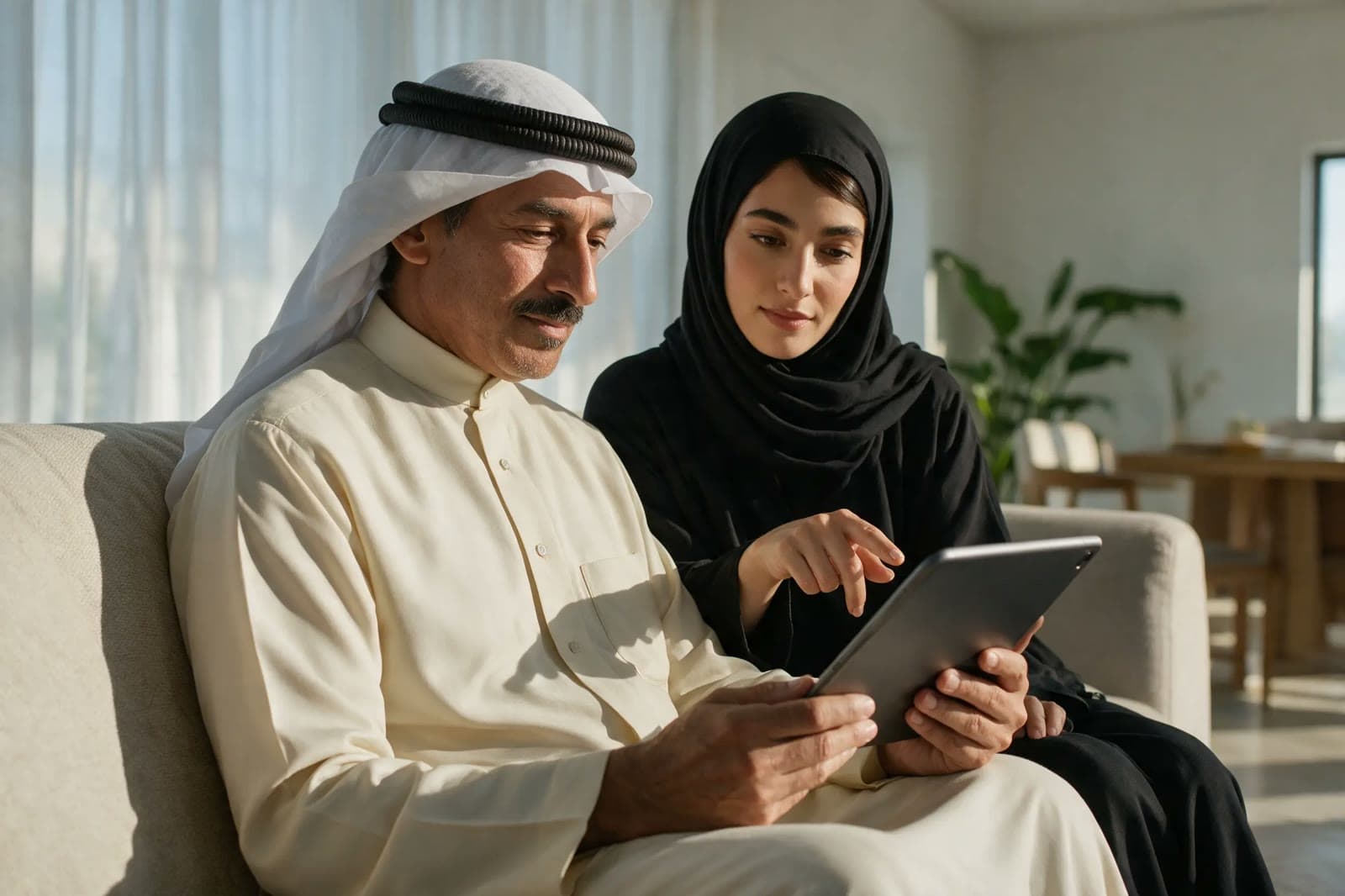 Step 1
Intake at homeAI-generated image · fictional people  Step 2
Video follow-upAI-generated image · fictional people 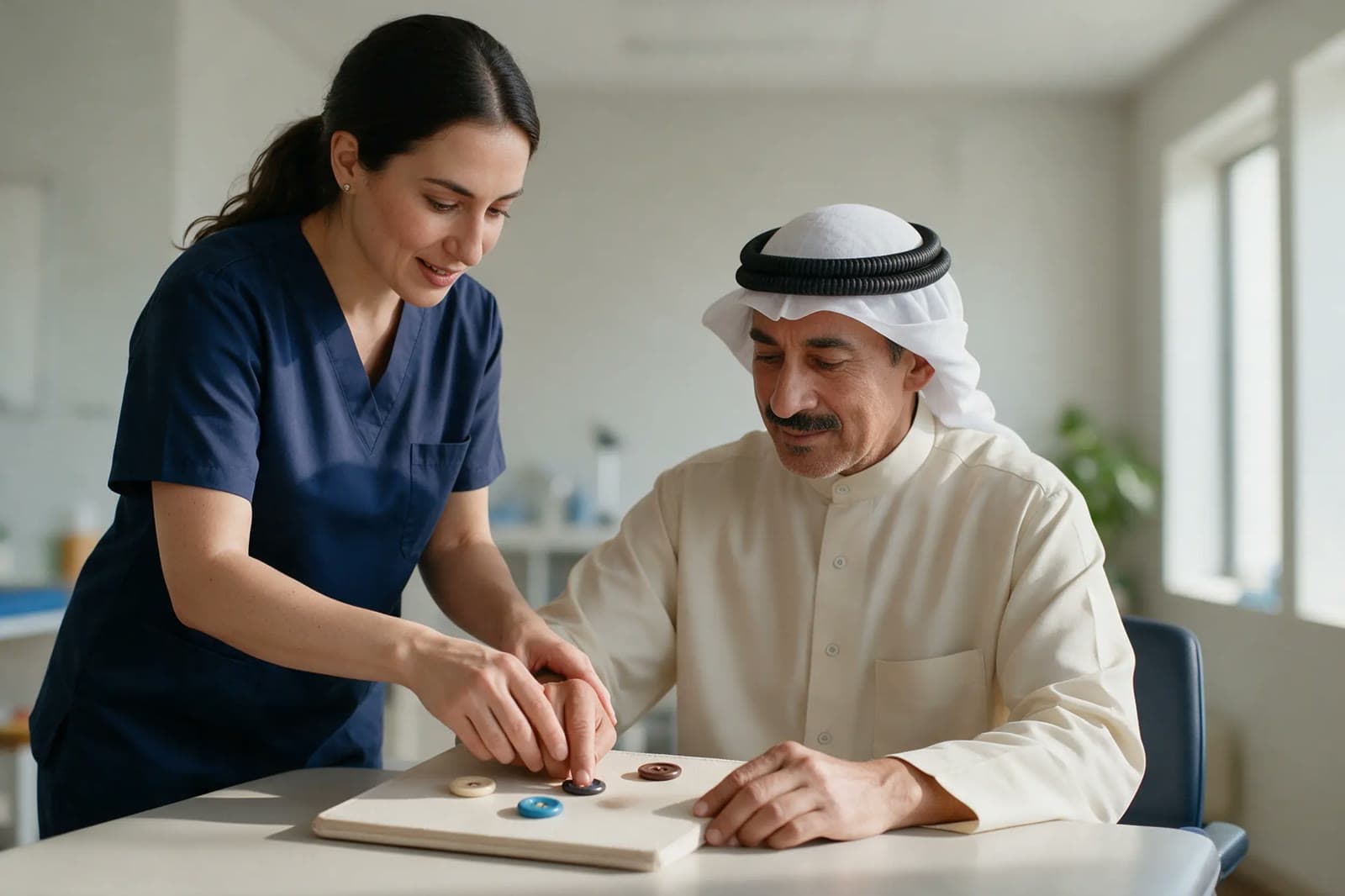 Step 4
TherapyAI-generated image · fictional people  Step 5
Daily lifeAI-generated image · fictional people
Intake
- Onboard
Khalid and Fatima complete a short structured intake: concerns, daily function, history and sharing.
Follow-up booking
- Booking
A video follow-up with the rehabilitation physician — for example 27 October, 14:00 Abu Dhabi time — appears in Care and in Pro.
Clinician review
- Pro
- Decision
The team reviews the intake in Pro; Decision sets it beside the notes and a prepared Aimedis AI summary to edit.
Shared care plan
- Decision
- Care
The clinician approves the plan deliberately; Khalid and Fatima read it in plain language in Care.
Continuing communication
- Connect
- Care
Questions and updates — such as fatigue to discuss at the next visit — reach the care team through Connect.
Connection to Aimedis Rehab
Referral out. Reviewed progress back.
A referral becomes a therapy plan in Aimedis Rehab, and reviewed progress returns to the clinical record — so neurological care and rehabilitation stay connected.
Scope: the Rehab integration and Rehab licensing are agreed separately — they are not part of the six-module base proposal.
Core platform
Referral approved in Decision
Relevant summary, goals and requested disciplines — sent only once Khalid's Rehab sharing is on.- Referral: from the core platform to Aimedis Rehab
Aimedis Rehab
Referral accepted
The rehabilitation team accepts it from the Rehab inbox.Aimedis Rehab
Therapy plan assigned
Three functional goals confirmed; the therapy appointment appears in Booking and the plan in Care.
Example goals
- Dress independently, including buttons
- Walk 300 metres outdoors with the cane — to the neighbourhood mosque
- Prepare a simple breakfast safely
Aimedis Rehab
Therapy session
A conventional session with a prepared note — or, within the agreed plan, the optional Aimedis XR activity.Aimedis Rehab
Therapist review
The therapist reviews the session summary before anything is published.- Reviewed progress: from Aimedis Rehab back to the core platform
Core platform
Back in Care and Pro
The published summary reports facts only, such as “1 of 3 planned sessions completed”.
Optional Aimedis XR
Immersive environments, linked to the rehabilitation plan
Optional extension · separately scoped and priced
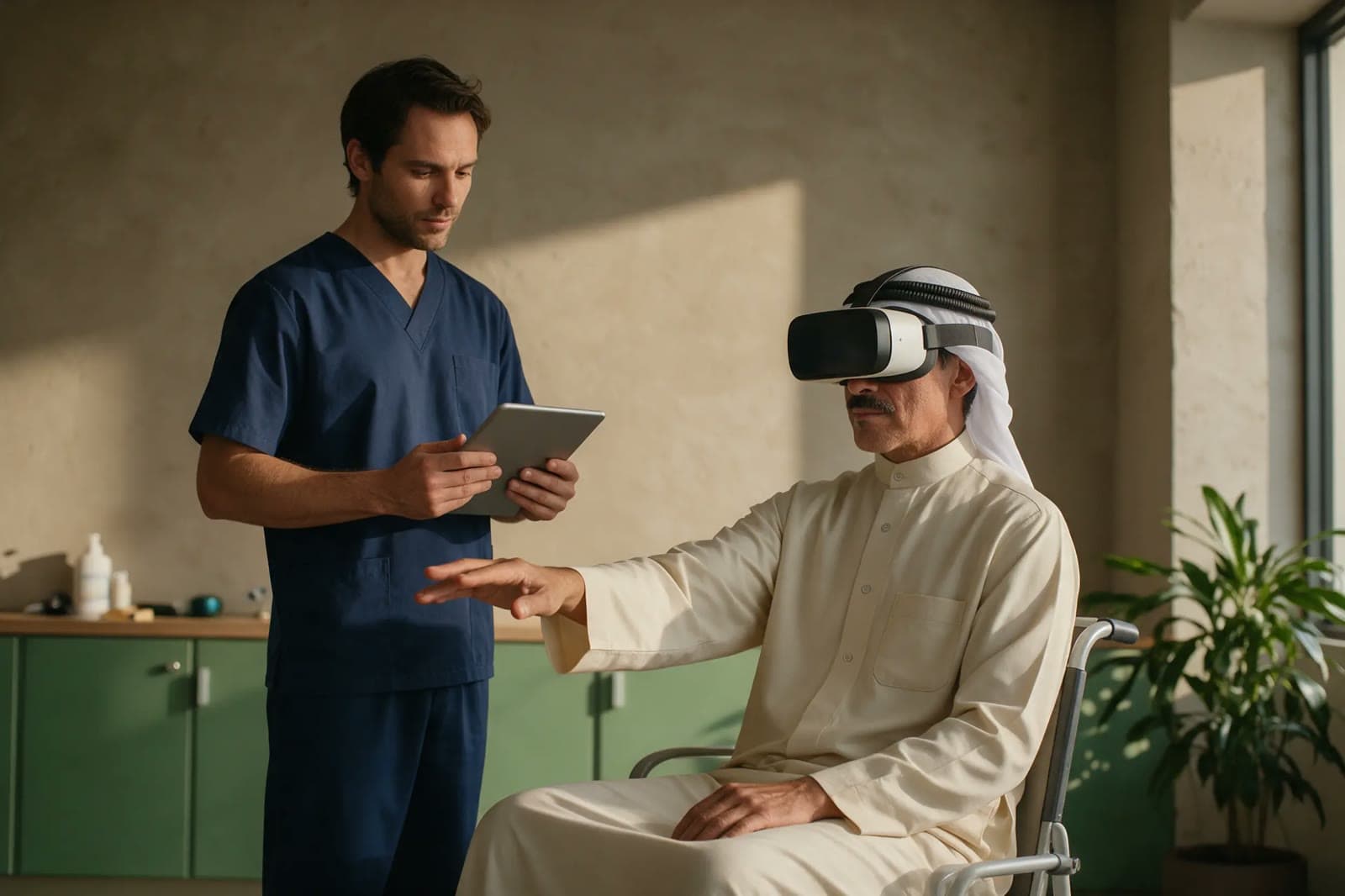
Aimedis XR provides immersive environments for healthcare education, simulation and collaboration. For this proposal we built one browser concept: a calm rehabilitation studio with a short sequence of targets.
Opened from this page, the concept is preview-only and writes nothing to Khalid's record. It runs in the browser — it is not a live Unreal Engine or streaming session.
Immersive rehabilitation
Selected therapist-directed activities linked to a rehabilitation plan.
Patient and family education
Guided explanations of the care journey in an immersive environment.
Team training and collaboration
Shared virtual clinical learning and multidisciplinary scenarios.
How it connects to Rehab
Within an agreed Rehab plan, a therapist can assign the XR activity instead of a conventional session. Only factual session data — active time, targets completed, completion or interruption — returns to Rehab, and the therapist reviews it before anything reaches Care or Pro.
Integration and UAE deployment
Built for Abu Dhabi: rules, clinical standards and your IT
A proposed architecture, the rules and clinical standards it is designed around, and the integration steps to agree with the IT teams of a leading hospital in Abu Dhabi. The platform will connect to the hospital's Epic hospital information system and to its billing system.
An implementation plan, not a compliance claim
Each row describes how the platform is designed to meet a rule or standard. Conformity is assessed together with the hospital during scoping, and this demonstration is connected to none of the systems shown.
- Implementation plan
- Part of the proposed design; confirmed in the Align phase.
- To be scoped
- Depends on the hospital's systems or an outside body; scoped before anything is agreed.
Proposed architecture
One platform in the UAE, connected to the systems around it
Patients and families on one side; on the other, the hospital's clinical systems — the Epic hospital information system and the billing system among them — with standard FHIR R4 interfaces in between.
Proposed design. The demonstration is not connected to any of these systems.
- Proposed platform connection
- To be scoped with the hospital
- Consent checked at each exchange
Patients & families
- Care appRecord and care plan
- Connect videoVideo visits and messages
- BookingAppointments
Aimedis AI Platform
UAE-hosted
Implementation planSix connected modules
- Onboard
- Booking
- Pro
- Decision
- Care
- Connect
Aimedis AIAssistant with a clinician in the loop
Optional extensions · separately scoped
- Aimedis Rehab
- Aimedis XR
Hospital clinical systems
To be scoped- Epic hospital information systemThe hospital's electronic health record
- Billing systemBillable visits and sessions
- Imaging (PACS)
- Laboratory
Around the platform
Identity
- To be scoped
UAE PASS
Patient sign-in
- Implementation plan
Hospital single sign-on
Staff sign-in
Abu Dhabi health information exchange
Malaffi
Integration to be scoped
To be scopedNational records: Riayati, Nabidh (via Malaffi)
Across every connection
- Consent at every exchange
- Audit trail
- Encryption in transit and at rest
- Keys held in the UAE
How the parts connect
- Patients and families reach the platform through Care, Connect and Booking: a proposed connection.
- The platform will exchange information with the hospital's clinical systems, including the Epic hospital information system and the billing system, through FHIR R4 APIs: the interfaces are to be scoped.
- The platform and Malaffi: integration to be scoped.
- Staff would sign in through hospital single sign-on (implementation plan) and patients through UAE PASS (to be scoped).
Rules and standards
Ten rules and standards, and how the platform is designed to meet them
Each row names the rule and its date, how the platform is designed to meet it, and the implementation phase that addresses it.
Rule 1: ADHICS version 228
DoH Abu Dhabi · effective August 2024
UAE-region hosting, including backup and disaster recovery; encryption at rest and in transit, with keys not supplied by the cloud host; mapping of the platform to the ADHICS controls.
Align and Configure
Implementation planRule 2: Federal Law on ICT in health29
UAE · Federal Law No. (2) of 2019
Storage and processing inside the UAE; retention of at least 25 years after the last health procedure.
Configure
Implementation planRule 3: Personal Data Protection Law31
UAE · Federal Decree-Law No. 45 of 2021
No cross-border transfer of personal data without an approved basis.
Align
Implementation planRule 4: Responsible AI Standard25
DoH Abu Dhabi · October 2025
Aimedis AI works with a clinician in the loop: every AI text is labelled, nothing enters the record without clinician approval, and it never diagnoses. Models are documented and monitored; conformity is assessed during scoping.
Align to Pilot
Implementation planRule 5: Digital Products Governance Standard27
DoH Abu Dhabi · effective August 2026
A product governance file, change control, and quality and safety documentation.
Configure
Implementation planVideo visits and teleconsultation workflows, with reporting such as teleconsultation within two working days of the request.
Configure and Pilot
Implementation planRule 7: Neuro-Rehabilitation Service Standards19
DoH Abu Dhabi · December 2025, effective April 2026
Telerehabilitation as a formal part of outpatient care, documented in Malaffi or the EMR; goal-based multidisciplinary plans.
Configure and Pilot
Implementation planRule 8: Standard for Stroke Management, version 220
DoH Abu Dhabi · effective September 2025
Support for teleconsultation-coordinated stroke follow-up and rehabilitation scope.
Pilot
To be scopedIntegration to be scoped with Malaffi; minimum controls in place before onboarding.
Expand
To be scopedRule 10: Clinical data standards
HL7 FHIR R4 and agreed terminologies
HL7 FHIR R4 resources; terminologies as agreed with the hospital and DoH (for example SNOMED CT, ICD-10, LOINC).
Configure
Implementation planRules as published by the Department of Health – Abu Dhabi and the UAE Government; see the Sources in the Hospital & UAE section.
Integration roadmap
Implementation planFour steps, from the system inventory to Malaffi
The phases of the implementation plan, seen through integration, hosting and standards. Dates are agreed once the scope is confirmed.
Align
- System inventory
- Data-protection impact assessment
- Consent model
Rules addressed
- Rule 1
- Rule 3
- Rule 4
Configure and connect
- FHIR interfaces to Epic and billing
- Single sign-on
- UAE hosting
Rules addressed
- Rule 1
- Rule 2
- Rule 4
- Rule 5
- Rule 6
- Rule 7
- Rule 10
Pilot
- Controlled cohort
- Monitoring
- Jawda reporting
Rules addressed
- Rule 4
- Rule 6
- Rule 7
- Rule 8
Expand
- Malaffi, once scoped
- More pathways
- Optional Aimedis Rehab and Aimedis XR
Rules addressed
- Rule 9
Implementation approach
Four phases, each with agreed outputs
A branded enterprise deployment, built on Aimedis's existing software and development know-how. Dates are agreed together once the scope is confirmed.
Align
Confirm the initial clinical pathways, programme leadership, branding, scope, integration inventory, consent model and commercial assumptions.
Outputs
- Agreed pathways and scope
- Integration inventory
- Consent model
Configure and connect
Adapt the six core modules, localise language and workflows, prepare the UAE environment and implement the agreed interfaces.
Outputs
- Configured, localised platform
- Prepared UAE environment
- Agreed interfaces in place
Pilot
Work with a controlled cohort: train teams, review clinical and operational workflows, and verify support and interoperability before broader use.
Outputs
- Trained teams
- Reviewed workflows
- Support and interoperability verified
Expand
Scale the agreed neurological pathways and progressively add the scoped Rehab connection and optional XR experiences.
Outputs
- Further agreed pathways
- Scoped Rehab connection
- Optional XR experiences
Primary demonstration pathway
Post-stroke follow-up
Neurological care and rehabilitation after discharge — the pathway Khalid's story follows.
Other potential neurological pathways
- Epilepsy
- Migraine
- Parkinson's disease
- Multiple sclerosis
- Cognitive conditions
Candidates for later phases; not separate workflows in this demonstration.
Measures to agree for the pilot
- Intake completion
- Appointment attendance
- Staff review effort
- Patient engagement
- Goal follow-up
Future measurements to agree together — not results or promised benefits.
Investment
Three parts, one connected platform
The proposed commercial structure for a non-exclusive enterprise deployment of the six core platforms. All amounts are in AED and exclude applicable taxes; the proposal is indicative and subject to final scope and agreement.
Implementation fee
AED 1,500,000
One-time
Upfront enterprise licence and implementation: branded deployment, agreed neurological adaptation, configuration, validation, training and rollout.
Monthly service fee
AED 60,000
Per month
Platform access, agreed infrastructure capacity, maintenance, security updates and defined support/SLA.
Active patient licence
AED 35
Per active patient per month
Use across the six core modules, with agreed usage allowances.
Proposed payment schedule
On signing
40% of the implementation fee
AED 600,000
On acceptance of the configured platform
40% of the implementation fee
AED 600,000
At go-live
20% of the implementation fee
AED 300,000
Estimated platform cost
Choose a monthly active-patient volume to see the core platform estimate.
A whole number from 0 to 20,000. 5,000 is a planning assumption, not an adoption statistic.
Core platform estimate
At 5,000 active patients per month
Recurring
- Monthly service fee
- AED 60,000
- Monthly patient fees5,000 active patients × AED 35
- AED 175,000
- Total monthly cost
- AED 235,000
- 12-month operating cost
- AED 2,820,000
Including the implementation fee
- Implementation fee (one-time, shown separately)
- AED 1,500,000
- Implementation + first 12 operating months
- AED 4,320,000
- Implementation + 36 operating months
- AED 9,960,000
- Effective recurring cost per active patient per month
- AED 47.00
Estimates assume the selected number of active patients in every operating month.
Changing the volume shows a cost scenario — not an adoption projection or a volume commitment.
Active patient — proposed definition
A unique patient receiving a consultation, submitting monitoring information or participating in a substantive care-team interaction during the calendar month. Count the patient once across all six core modules, regardless of repeat visits. Passive stored records and automated reminders alone do not count.
Active patients are not registered accounts, new registrations or appointment counts.
Optional extensions
Select extensions to include them in the scoping discussion. They do not change the core platform estimate.
Include Aimedis Rehab connection
Referral handoff, goals, sessions and reviewed progress between the platform and Aimedis Rehab.
Include Aimedis XR
Immersive environments for selected rehabilitation, education and team-training use cases.
Monthly core platform cost by volume
AED per month
Active patients per month
| Active patients per month | Core platform estimate per month |
|---|---|
| 0 | AED 60,000 |
| 5,000 (selected volume) | AED 235,000 |
| 10,000 | AED 410,000 |
| 15,000 | AED 585,000 |
| 20,000 | AED 760,000 |
Cumulative cost over 36 operating months
AED, at 5,000 active patients per month
Operating month
| Operating month | Cumulative core platform estimate |
|---|---|
| 0, implementation fee | AED 1,500,000 |
| 6 | AED 2,910,000 |
| 12 | AED 4,320,000 |
| 18 | AED 5,730,000 |
| 24 | AED 7,140,000 |
| 30 | AED 8,550,000 |
| 36 | AED 9,960,000 |
Both charts follow the volume chosen above and show the core platform estimate only; optional extensions are not included. The service-fee floor is the monthly service fee of AED 60,000, charged at every volume.
Commercial notes
- Proposed contract term: 36 operating months, with the rollout and commitments agreed commercially.
- Recurring fees start at the agreed go-live. “First 12 months” means the first 12 full operating months after go-live, not necessarily the first 12 months after signing.
- Aimedis retains its underlying platform IP. Exclusivity, sublicensing and source-code ownership are separately negotiated rights.
- Sites, clinical users, supported integrations and support hours are defined in the statement of work.
- Additional integrations, substantial new features, clinical staffing, hardware and consumption above agreed allowances are separately scoped.
- Aimedis Rehab integration and licensing, and Aimedis XR content, hardware or streaming, are separately scoped options; no prices are shown for them.
- All amounts exclude applicable taxes.
- The 5,000-patient volume is an estimate unless a contractual minimum is agreed. This proposal is indicative and subject to final scope and agreement.
Investment summary
Selected volume: 5,000 active patients per month
Recurring
- Monthly service fee
- AED 60,000
- Monthly patient fees5,000 active patients × AED 35
- AED 175,000
- Total monthly cost
- AED 235,000
- 12-month operating cost
- AED 2,820,000
Including the implementation fee
- Implementation fee (one-time, shown separately)
- AED 1,500,000
- Implementation + first 12 operating months
- AED 4,320,000
- Implementation + 36 operating months
- AED 9,960,000
- Effective recurring cost per active patient per month
- AED 47.00
Optional extensions
No optional extensions selected.
Estimates assume the selected number of active patients in every operating month.
All amounts exclude applicable taxes.
The 5,000-patient volume is an estimate unless a contractual minimum is agreed. This proposal is indicative and subject to final scope and agreement.
Return on investment
About AED 1.94 back for every AED 1, once running
A three-year model for a leading hospital in Abu Dhabi, in AED. Costs use this proposal's prices plus an estimate of the hospital's own team time; value uses conservative benchmark figures and a few stated planning assumptions about the hospital. In the expected case, the platform pays for itself about 20 months after go-live.
- value a year once fully running, in the expected case
- AED 5.87M
- gain over three years after all costs (≈ USD 1.0M)
- +AED 3.59M
- return on investment over three years; +58% over five years
- +36%
- until the platform has paid for itself, counted from go-live
- ≈ 20 months
What the hospital pays
About AED 9.9M over three years, every cost included
The proposal's fees, with the active-patient count ramping up during year 1, plus an estimate of the hospital's own team time. Excluding VAT and the optional Aimedis Rehab and Aimedis XR extensions.
| Cost | Year 1 | Year 2 | Year 3 |
|---|---|---|---|
| Implementation feeOne-time: 40% on signing, 40% on acceptance, 20% at go-live | 1.50 | none | none |
| Monthly service feeAED 60,000 a month | 0.72 | 0.72 | 0.72 |
| Active patient licencesAED 35 per active patient a month; year 1 averages 2,500 patients while volume ramps up, then 5,000 | 1.05 | 2.10 | 2.10 |
| The hospital's own team timeProject, clinical and IT staff — an estimate | 0.60 | 0.20 | 0.20 |
| Total | 3.87 | 3.02 | 3.02 |
Three-year total AED 9.91M (≈ USD 2.7M). At 5,000 active patients from the first operating month, the investment estimate above comes to AED 9.96M; it leaves out the hospital's own team time.
Where the hospital saves and makes money
Six sources of value, about AED 5.87M a year
Yearly value once the platform is fully running at 5,000 active patients. Each bar shows the expected case; the thin line beneath it runs from the low to the high case.
- Saves
Shorter hospital stays
Earlier, safe discharge, supported by home readings, video follow-up, remote rehabilitation and the family app.
Expected-case assumption: 600 stroke and neuro discharges a year, each 1 day shorter, at AED 3,000 per freed bed-day.
AED 1.80Ma year
Low 0.75M · high 3.15M
- Earns
Physician time turned into visits
Aimedis AI drafts visit notes, pre-visit summaries and letters for the physician to review and sign.
Expected-case assumption: 20 physicians each save 30 minutes a day; half of that time becomes extra 20-minute follow-up visits at AED 450.
AED 1.49Ma year
Low 0.45M · high 2.67M
- Earns
More rehabilitation kept at the hospital
Built-in referral and remote rehabilitation sessions, so patients don't leave for rehabilitation elsewhere.
Expected-case assumption: 120 extra rehabilitation courses a year, each of 20 sessions at AED 350.
AED 0.84Ma year
Low 0.35M · high 1.40M
- Earns
Fewer missed appointments
Reminders, a video option and easy rescheduling.
Expected-case assumption: 50,000 visits a year; 15% are missed today and a quarter of those are recovered, at AED 400 a visit.
AED 0.75Ma year
Low 0.36M · high 1.42M
- Earns
Therapist time turned into sessions
AI-drafted home exercise sheets and progress notes for the therapist to review.
Expected-case assumption: 40 therapists each save 15 minutes a day; half of that time becomes extra 45-minute sessions at AED 350.
AED 0.51Ma year
Low 0.21M · high 0.82M
- Saves
Less admin and translation work
Digital intake, automated scheduling and Arabic–English support.
Expected-case assumption: The work of 2 front-desk or call-centre staff (AED 180,000 a year each) plus AED 120,000 of interpreting time.
AED 0.48Ma year
Low 0.24M · high 0.72M
All six, fully running
AED 5.87Ma year
Low 2.35M · high 10.18M
Return by scenario
Pays back in about 20 months in the expected case
Value builds up to 40% of the full yearly value in year 1, 90% in year 2 and 100% from year 3. Costs follow the table above, with the implementation fee at go-live.
Cumulative net cash after all costs
AED million, by month after go-live
Months after go-live
Point at the chart, or focus it and use the arrow keys, to read any month.
| Month | High | Expected | Low |
|---|---|---|---|
| 0 | −1.50 | −1.50 | −1.50 |
| 6 | −0.65 | −1.51 | −2.21 |
| 12 | +0.20 | −1.52 | −2.93 |
| 18 | +3.27 | −0.39 | −3.38 |
| 24 | +6.35 | +0.74 | −3.83 |
| 30 | +9.93 | +2.16 | −4.17 |
| 36 | +13.51 | +3.59 | −4.50 |
| Measure | Low | Expected | High |
|---|---|---|---|
| Value a year, fully running | 2.35 | 5.87 | 10.18 |
| Value per AED 1 of yearly cost, fully running | 0.78 | 1.94 | 3.37 |
| Three-year value | 5.41 | 13.50 | 23.42 |
| Three-year gain after all costs | −4.50 | +3.59 | +13.51 |
| Three-year ROI | −45% | +36% | +136% |
| Payback | not within three years | about month 20 | about month 11 |
| Five-year ROI, if continued | −37% | +58% | +174% |
The simple version
For the hospital's leadership
2.6 beds
cover the platform's monthly fees
The platform's monthly fees of AED 235,000 equal about 78 bed-days, or 2.6 beds. If earlier discharge frees about three beds' worth of stays, the platform pays for itself.
1.4 visits
per physician per working day cover it too
Equivalently, about 1.4 extra follow-up visits per physician per working day cover the fees.
AED 3.03M
a year from three hard-cash levers
Three hard-cash levers alone cover the whole running cost: shorter stays (AED 1.80M), fewer missed appointments (AED 0.75M) and admin savings (AED 0.48M) add up to AED 3.03M a year, against AED 3.02M a year. All the extra clinician capacity and rehabilitation growth then comes on top as additional revenue.
AED 98
expected value per patient a month, for AED 47 of fees
Per patient, the platform's fees come to AED 47 a month (at 5,000 patients) and the expected value about AED 98 a month. Because the fixed fee is spread over more patients, adding further conditions (epilepsy, MS, Parkinson's) improves the ratio.
Value not counted above
More value for patients, payers and Abu Dhabi
These benefits go mostly to payers, patients or the health system rather than to the hospital's accounts, but they strengthen the case with the Department of Health and with insurers such as Thiqa and Daman.
- Fewer readmissions.
- Fewer emergency visits.
- Less travel for patients and families, thanks to video visits.
- Earlier return to work: the hospital's stroke patients are young — on average 55, and 62% under 60.1
- Fit with Abu Dhabi rules: remote rehabilitation is recognised in the new DoH neuro-rehabilitation standards, and video care counts toward the DoH's telehealth quality indicators.19,24
- Longer-term upside: keeping international and GCC patients in follow-up, and building research data.
Next steps
A scoping workshop to shape the pilot
We propose a short joint workshop on five topics.
Prints a paper version of this proposal.
Clinical pathways
Confirm the first pathways, starting with post-stroke follow-up.
Integration inventory
List the systems, identifiers and data flows involved.
Patient-volume assumptions
Test the planning assumption of 5,000 active patients a month.
Support requirements
Agree sites, clinical users, support hours and service levels.
Optional Rehab and XR scope
Decide whether, and how, to scope the extensions.